

pippa
A terminal UI framework for MoonBit, inspired by bubbletea (Go) and Elm architecture. Provides a Model-Update-View pattern with typed messages, ANSI rendering, and composable components.
tui
terminal
framework
elm
bubbletea
ansi
moon add brickfrog/pippa@0.1.0
Download zipAuthor
Version
0.1.0
License
Apache-2.0
Repository
Last updated
2 months ago
Downloads
28
Dependencies
 README
#Pippa
A terminal UI framework for MoonBit, inspired by
bubbletea (Go) and the
Elm Architecture.
#Overview
Pippa provides a Model–Update–View pattern where:
- Model — application state is a plain struct.
- Msg — updates are driven by typed messages (key presses, resize, timers, custom events).
- View — the view function renders state to a string of ANSI-formatted output.
The runtime handles raw terminal mode, input parsing, and efficient
diffing and re-rendering, so library users only think about state transitions
and string output.
A component library ships alongside the core — spinners, text inputs, textareas,
lists, selection lists, tables, paginators, viewports, timers, stopwatches,
file pickers, and animated progress bars — each implemented as composable
Models that can be embedded in larger applications.
The main @pippa package includes visual styling and layout helpers:
hex/RGB colors, borders, padding, margins, joins, placement, and the
col/row/lines/text/gap/hgap layout DSL. There is no separate
styling package.
#Quick Start
moon test
moon run src/examples/showcase
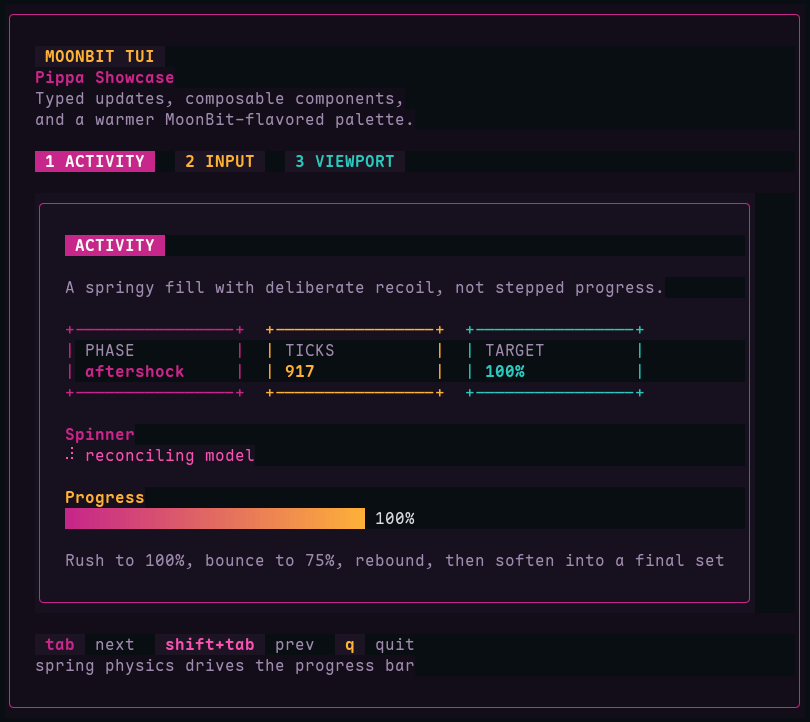
The showcase example exercises the runtime, components, styling, spring
animation, focus handling, and viewport behavior.
#Keymaps and Help
Key bindings separate activation keys from display help. Prefer constructors
over raw struct literals:
let quit = binding(keys=["q", "ctrl+c"], help_key="q", help="quit")
let model = help_model(
  keymap=keymap([quit]),
  show_full=false,
  width=80,
)
let footer = help_view(model)
When migrating older code, replace flat Binding::{ keys, help } values with
binding(keys=..., help_key=..., help=...). Replace
HelpModel::{ bindings, show_full } with help_model(keymap=keymap(bindings),show_full=..., width=...). Disabled or unbound bindings do not match and are
omitted from both short and full help.
#View Surface
The common Program::new(..., view=fn(model) { "..." }) shape remains a plain
Model -> String function. Apps that need per-render terminal state can opt in
with one extra builder call:
let program = Program::new(
    init=my_init,
    update=my_update,
    view=my_string_view,
  )
  .with_structured_view(fn(model) {
    View::text(my_string_view(model))
    .with_window_title("Pippa")
    .with_cursor_visible(true)
  })
For now, the renderer uses View.content exactly like the old string view. The
optional cursor, title, color, progress, and mouse-mode fields are carried with
the frame for the next renderer pass.
#Project Structure
src/                          # Source root (moon.mod.json → source: "src")
├── moon.pkg                  # Core library package
├── types.mbt                 # Cmd, UpdateResult, WindowSize, Program
├── message.mbt               # KeyMsg, MouseMsg, InputEvent
├── command.mbt               # Command helpers and composition
├── program.mbt               # Program[Model, Msg] entry point
├── ansi.mbt                  # ANSI escape sequence helpers
├── style.mbt                 # Style, Color, borders, and placement
├── view.mbt                  # col/row/lines/text/gap/hgap layout DSL
├── component/                # Composable component sub-package
│   ├── moon.pkg
│   └── ...                   # Spinner, textarea, viewport, progress, etc.
└── examples/
    ├── hello/                # Minimal example app
    ├── structured-view/      # View.content plus per-frame terminal state
└── showcase/ # Rich interactive demo#Development
moon check          # Type-check the project
moon fmt            # Format all source files
moon info           # Refresh generated package interfaces
moon test           # Run all tests
moon test --update  # Run tests and update snapshots
moon run src/examples/hello  # Run the hello example
moon run src/examples/structured-view  # Run the structured View example
moon run src/examples/showcase # Run the showcase demo#License
Apache-2.0
#Align
Horizontal alignment within a styled width.
#Binding
A named key binding with activation keys, display help, and enabled state.
#Border
Border characters used to render a box around styled content.
#CapabilityReply
XTGETTCAP terminal capability reply payload.
#ClipboardPayload
Payload returned by an OSC 52 clipboard reply.
#ClipboardReply
pub(all) struct ClipboardReply {
selection : ClipboardSelection
payload : ClipboardPayload
} derive(Eq, Debug)OSC 52 clipboard reply payload.
#ClipboardSelection
Selection target used by OSC 52 clipboard queries and replies.
#Cmd
type Cmd[Msg]A batch of I/O commands to be performed by the runtime.
Cmd[Msg] represents one-shot runtime effects that may later produce a
message of type Msg and feed it back into the update loop.
Commands are additive: when several updates happen in one runtime turn, the
resulting commands are all enqueued rather than the "last" one replacing the
others. Use Cmd::none() for no-ops and Cmd::batch to combine several
commands.
A batch of one-shot runtime effects.

#Cmd::after
Schedule f() after interval_ms milliseconds.
The runtime evaluates f when the timer fires, not when the command is
created.
#Cmd::batch
Batch multiple commands so each effect is enqueued independently.
#Cmd::clear_screen
Clear the screen and move the cursor to the home position.
#Cmd::clear_window_title
Clear the terminal window title at runtime.
#Cmd::disable_bracketed_paste
Disable terminal bracketed paste mode at runtime.
#Cmd::disable_focus_reporting
Disable terminal focus reporting at runtime.
#Cmd::disable_mouse
Disable terminal mouse reporting at runtime.
#Cmd::enable_bracketed_paste
Enable terminal bracketed paste mode at runtime.
#Cmd::enable_focus_reporting
Enable terminal focus reporting at runtime.
#Cmd::enable_mouse_all_motion
Enable all terminal mouse motion reporting at runtime.
#Cmd::enable_mouse_cell_motion
Enable terminal mouse press, release, wheel, and button-held drag reporting at runtime.
#Cmd::enter_alt_screen
Enter the terminal alternate screen buffer at runtime.
#Cmd::every
Schedule f once on the next aligned interval boundary.
Alignment is measured against the runtime's monotonic millisecond clock:
the deadline is the next strict multiple of interval_ms. The callback
receives a typed elapsed-time payload, and apps that want recurrence should
return another Cmd::every from update.
#Cmd::exec_process
Run an external process while the runtime releases the terminal.
#Cmd::exit_alt_screen
Exit the terminal alternate screen buffer at runtime.
#Cmd::force_redraw
Invalidate the renderer cache so the next render fully repaints.
#Cmd::is_none
Returns true when the command carries no actions (equivalent to Cmd::none()).
#Cmd::map
Map the message type of a command, transforming runtime-produced messages.
#Cmd::msg
Enqueue a message to be delivered immediately by the runtime.
#Cmd::perform
Execute a runtime effect immediately after the current update cycle.
The runtime runs f on the event loop thread and feeds the resulting
message back into update when Some(msg) is returned.
#Cmd::print_above
Print unmanaged text above the program in inline terminal mode.
The printed text is not part of the managed view and may persist in terminal
scrollback across later renders. The runtime prints each newline-delimited
line on its own terminal line, then repaints the current view below it. When
the alternate screen is active the request is discarded, matching Bubble Tea's
Println / Printf behavior.
#Cmd::printf
Format unmanaged text and print it above the program in inline terminal mode.
Pippa accepts pre-rendered string arguments and replaces %s placeholders in
template from left to right; %% emits a literal percent sign. The result is
then handled like Cmd::println, including the alt-screen no-op behavior.
#Cmd::println
Print unmanaged text above the program in inline terminal mode.
This is the Pippa equivalent of Bubble Tea's Println: unlike writing from a
view, the line is outside the managed render area and is ignored while the
alternate screen is active.
#Cmd::repaint
Invalidate the renderer cache so the next render fully repaints.
#Cmd::request_background_color
Request the current default background color (OSC 11).
#Cmd::request_capability
Request a terminal capability with XTGETTCAP.
#Cmd::request_clipboard
Request clipboard contents with OSC 52.
#Cmd::request_cursor_position
Request the current cursor position (DSR CPR) from the terminal.
#Cmd::request_device_attributes
Request primary device attributes (DA1) from the terminal.
#Cmd::request_foreground_color
Request the current default foreground color (OSC 10).
#Cmd::request_secondary_device_attributes
Request secondary device attributes / terminal version (DA2).
#Cmd::request_window_size
Ask the runtime to deliver the current terminal size as a typed message.
#Cmd::resume_program
Ask the runtime to deliver a resume lifecycle message.
#Cmd::runtime_error
Stop the runtime with a typed runtime error result.
#Cmd::sequence
Run commands in order.
Each command starts only after the prior command's immediate effects have
been drained by the runtime. Delayed timers from earlier steps continue to
run independently once scheduled.
#Cmd::set_clipboard
Set system clipboard contents with OSC 52.
#Cmd::set_clipboard_for
Set clipboard contents for an OSC 52 selection.
#Cmd::set_cursor_style
Set the real terminal cursor shape/blink style at runtime.
#Cmd::set_window_title
Set the terminal window title at runtime.
#Cmd::suspend
Ask the runtime to release and then re-acquire the terminal.
#Color
Rich color representation used by the styling APIs.
#CursorPositionReply
1-based cursor location reported by a terminal CPR reply.
#CursorStyle
Real terminal cursor shape/blink styles for DECSCUSR.
#EnhancedKeyCode
Numeric key identity reported by enhanced terminal keyboard protocols.
#EnhancedKeyEventType
Press, repeat, or release phase for an enhanced keyboard event.
#EnhancedKeyModifier
Canonical modifiers reported by enhanced terminal keyboard protocols.
#EnhancedKeyMsg
pub(all) struct EnhancedKeyMsg {
code : EnhancedKeyCode
shifted : EnhancedKeyCode?
base_layout : EnhancedKeyCode?
modifiers : Array[EnhancedKeyModifier]
event_type : EnhancedKeyEventType
text_codepoints : Array[Int]
} derive(Eq, Debug)Keyboard event data from Kitty / CSI-u enhanced keyboard reports.
#ExecProcess
External process request run by Cmd::exec_process.
#ExecProcess::new
Create an external process request.
#ExecResult
Result of an external process run.
#HelpModel
A help model for rendering keybinding hints at the bottom of a view.
#InputEvent
pub(all) enum InputEvent {
Key(KeyMsg)
EnhancedKey(EnhancedKeyMsg)
Mouse(MouseMsg)
Focus
Blur
Paste(String)
TerminalReply(TerminalReplyMsg)
Unknown(Bytes)
} derive(Eq, Debug)A parsed terminal input event.
#InternalMsg
pub(all) enum InternalMsg {
KeyPress(Array[Byte])
WindowResize(WindowSize)
Lifecycle(LifecycleMsg)
QuitRequested
} derive(Eq, Debug)Built-in messages that the Pippa runtime can emit.
Users extend their own Msg enum to wrap InternalMsg when they need
to react to terminal events.
#KeyMap
Ordered groups of key bindings for matching and help rendering.
#KeyMapGroup
A named group of bindings, rendered as a section in full help.
#KeyMsg
Represents a keyboard event.
#LifecycleMsg
Lifecycle messages emitted by the runtime and lifecycle commands.
#MouseAction
Mouse event action.
#MouseButton
Mouse button, no-button motion sentinel, or wheel scroll direction.
#MouseModifier
Keyboard modifiers attached to a mouse event.
#MouseMsg
pub(all) struct MouseMsg {
button : MouseButton
action : MouseAction
modifiers : Array[MouseModifier]
col : Int
row : Int
} derive(Eq, Debug)Represents a mouse event.
#Nothing
Sentinel type for commands that carry no payload.
#ParseResult
Result of attempting to parse one event from a byte buffer.
#PatchOp
A single patch operation: move to (row, col) and replace the line with text.
#Program
pub(all) struct Program[Model, Msg] {
  init : () -> UpdateResult[Model, Msg]
  update : (Model, Msg) -> UpdateResult[Model, Msg]
  view : (Model) -> String
  structured_view : (Model) -> View?
  sub : (InputEvent) -> Msg?
  on_tick : () -> Msg?
  mouse : Bool
  alt_screen : Bool
  focus_reporting : Bool
  bracketed_paste : Bool
  hide_cursor : Bool
  synchronized_output : Bool
  rendering : Bool
  read_stdin : Bool
  input : () -> Array[InputEvent]?
  raw_input : () -> Bytes?
  cancelled : () -> Bool?
  fps : Int
  window_width : Int
  window_height : Int
  output : (String) -> Unit
  on_window_size : (WindowSize) -> Msg?
  on_resize : (Int, Int) -> Msg?
  should_quit : (Model) -> Bool
  catch_interrupt : Bool
  on_lifecycle : (LifecycleMsg) -> Msg?
  exec_runner : (ExecProcess) -> ExecResult
  suspend_runner : () -> Unit
}
Configuration for a Pippa application.
#Program::headless
#Program::new
fn[Model, Msg] Program::new(init~ : () -> UpdateResult[Model, Msg], update~ : (Model, Msg) -> UpdateResult[Model, Msg], view~ : (Model) -> String, sub? : (InputEvent) -> Msg?, on_tick? : () -> Msg?, mouse? : Bool, alt_screen? : Bool, focus_reporting? : Bool, bracketed_paste? : Bool, hide_cursor? : Bool, synchronized_output? : Bool, rendering? : Bool, read_stdin? : Bool, input? : () -> Array[InputEvent]?, raw_input? : () -> Bytes?, cancelled? : () -> Bool?, fps? : Int, window_width? : Int, window_height? : Int, output? : (String) -> Unit, on_resize? : (Int, Int) -> Msg?, should_quit? : (Model) -> Bool, catch_interrupt? : Bool, on_window_size? : (WindowSize) -> Msg?, on_lifecycle? : (LifecycleMsg) -> Msg?, exec_runner? : (ExecProcess) -> ExecResult, suspend_runner? : () -> Unit) -> Program[Model, Msg]Create a new Program from init, update, and view functions.
#Program::run
Run the program.
On native and llvm targets this enters raw terminal mode and drives
the main event loop. On other targets this initializes the model, exposes
an already-closed handle to run_with_handle, and returns RunCompleted.
#Program::run_with_handle
fn[Model, Msg] Program::run_with_handle(program : Program[Model, Msg], on_start : (ProgramHandle[Msg]) -> Unit) -> RunResult[Model]Run the program and expose a handle that can inject messages while it is
running.
#Program::with_alt_screen
#Program::with_bracketed_paste
#Program::with_cancelled
#Program::with_catch_interrupt
#Program::with_exec_runner
fn[Model, Msg] Program::with_exec_runner(self : Program[Model, Msg], exec_runner : (ExecProcess) -> ExecResult) -> Program[Model, Msg]#Program::with_focus_reporting
#Program::with_fps
#Program::with_hide_cursor
#Program::with_input
fn[Model, Msg] Program::with_input(self : Program[Model, Msg], input : () -> Array[InputEvent]) -> Program[Model, Msg]#Program::with_lifecycle
fn[Model, Msg] Program::with_lifecycle(self : Program[Model, Msg], on_lifecycle : (LifecycleMsg) -> Msg?) -> Program[Model, Msg]#Program::with_output
#Program::with_raw_input
#Program::with_rendering
#Program::with_stdin
#Program::with_structured_view
Install an opt-in structured view while preserving the plain string view as
a fallback for callers that do not need per-frame terminal state.
#Program::with_suspend_runner
#Program::with_synchronized_output
#ProgramHandle
type ProgramHandle[Msg]Handle for sending messages to a running program.
send is intended for the same MoonBit runtime thread. Native cross-thread
delivery of generic MoonBit values is not supported by the runtime today.
#ProgramHandle::is_closed
Returns true after the program has exited and the handle can no longer send.
#ProgramHandle::release_terminal
Temporarily restore the terminal to its outer shell state.
#ProgramHandle::restore_terminal
Re-enter Pippa's managed terminal state after release_terminal.
#ProgramHandle::send
Enqueue a message for delivery to the running program.
#RunResult
pub(all) enum RunResult[Model] {
RunCompleted(Model)
RunQuit(Model)
RunInterrupted(Model)
RunRuntimeError(String)
RunExec(Model, ExecResult)
} derive(Debug)Typed result returned by Program::run.
#Style
pub(all) struct Style {
fg : Int?
bg : Int?
fg_ext : Color?
bg_ext : Color?
border_fg : Color?
border_bg : Color?
bold : Bool
dim : Bool
italic : Bool
underline : Bool
blink : Bool
reverse : Bool
strikethrough : Bool
border : Border?
border_top : Bool
border_right : Bool
border_bottom : Bool
border_left : Bool
padding_top : Int
padding_bottom : Int
padding_left : Int
padding_right : Int
margin_top : Int
margin_bottom : Int
margin_left : Int
margin_right : Int
width : Int
height : Int?
min_width : Int
min_height : Int
max_width : Int?
max_height : Int?
align : Align
} derive(Eq, Debug)A composable style description for terminal strings.
#Style::background_rgb
#Style::border_sides
#Style::foreground_rgb
#Style::margin
#Style::padding
#Style::render_with
#TerminalColorReply
Color value reported by OSC terminal color queries.
#TerminalReplyMsg
pub(all) enum TerminalReplyMsg {
CursorPosition(CursorPositionReply)
DeviceAttributes(Array[Int])
SecondaryDeviceAttributes(Array[Int])
Color(TerminalColorReply)
Capability(CapabilityReply)
Clipboard(ClipboardReply)
UnknownReply(Bytes)
} derive(Eq, Debug)Replies emitted by terminal query sequences.
#TimerTick
Typed payload delivered to scheduler callbacks.
#UpdateResult
The result of an update call: the new model and an optional command.
#UpdateResult::new
Create an UpdateResult from a model and a command.
#VerticalAlign
Vertical alignment for layout helpers.
#View
pub(all) struct View {
content : String
cursor_position : ViewCursorPosition?
cursor_visible : Bool?
window_title : String?
cursor_style : CursorStyle?
foreground_color : Color?
background_color : Color?
progress : ViewProgress?
mouse_mode : ViewMouseMode?
} derive(Eq, Debug)Structured render output for a single frame.
content is rendered exactly like the string returned by a traditional
view function. The optional fields describe terminal state that should
travel with the frame; emitting escape sequences for those fields is handled
by later render plumbing.
#View::new
fn View::new(content~ : String, cursor_position? : ViewCursorPosition?, cursor_visible? : Bool?, window_title? : String?, foreground_color? : Color?, background_color? : Color?, progress? : ViewProgress?, mouse_mode? : ViewMouseMode?, cursor_style? : CursorStyle?) -> ViewCreate a structured View with explicit optional terminal state.
#View::text
Wrap plain string content as a structured View.
#View::with_background_color
Set the default background color for this frame.
#View::with_cursor_position
Set the cursor position for this frame.
#View::with_cursor_style
Set the real terminal cursor shape/blink style for this frame.
#View::with_cursor_visible
Set cursor visibility for this frame.
#View::with_foreground_color
Set the default foreground color for this frame.
#View::with_mouse_mode
Set the mouse reporting mode for this frame.
#View::with_progress
Set terminal progress state for this frame.
#ViewCursorPosition
Cursor position requested by a structured View.
#ViewCursorPosition::new
Create a 1-based cursor position, clamping invalid terminal coordinates to 1.
#ViewMouseMode
Mouse reporting mode requested by a structured View.
#ViewProgress
Per-render terminal progress state carried by a structured View.
#WindowSize
A window resize event payload.
#begin_sync_update
fn begin_sync_update() -> StringBegin synchronized output mode (CSI ? 2026 h).
#bg_color
fn bg_color(n : Int) -> StringSet the background color (256-color mode: CSI 48 ; 5 ; n m).
#bg_rgb
fn bg_rgb(r : Int, g : Int, b : Int) -> StringSet the background to an RGB color (CSI 48 ; 2 ; r ; g ; b m).
#center
fn center(s : String, width : Int) -> StringCenter s within a field of width visible characters by padding with
spaces on both sides. Returns s unchanged if its visible width is
already ≥ width.
#clear_screen_below
fn clear_screen_below() -> StringClear from cursor to end of screen (CSI J).
#clear_terminal_progress
fn clear_terminal_progress() -> StringClear terminal progress using OSC 9;4 state 0.
#clear_window_title
fn clear_window_title() -> StringClear the terminal window title using OSC 2 with an empty title.
#col
Vertical layout — stacks children separated by newlines.
Designed for use with the <| operator:
col <| [
  "header",
  row <| ["a", " ", "b"],
  "footer",
]#diff_views
Compare two view strings line-by-line and return the minimal set of
PatchOps needed to transform the old view into the new view.
- Changed or added lines → emit a PatchOp with the new line text.
- Lines present in old_view but absent in new_view → emit a PatchOp with text = "" to clear the stale line.
#disable_bracketed_paste
fn disable_bracketed_paste() -> StringDisable bracketed paste mode (CSI ?2004l).
#disable_focus_reporting
fn disable_focus_reporting() -> StringDisable focus reporting (CSI ?1004l).
#disable_mouse
fn disable_mouse() -> StringDisable all mouse reporting (CSI ?1000l, CSI ?1002l, CSI ?1003l, and CSI ?1006l).
#enable_bracketed_paste
fn enable_bracketed_paste() -> StringEnable bracketed paste mode (CSI ?2004h).
#enable_focus_reporting
fn enable_focus_reporting() -> StringEnable focus reporting (CSI ?1004h).
#enable_mouse
fn enable_mouse() -> StringEnable normal mouse reporting with SGR coordinates (CSI ?1000h CSI ?1006h).
#enable_mouse_cell_motion
fn enable_mouse_cell_motion() -> StringEnable mouse button-event reporting with SGR coordinates (CSI ?1002h CSI ?1006h).
#enable_mouse_motion
fn enable_mouse_motion() -> StringEnable mouse motion reporting with SGR coordinates (CSI ?1003h CSI ?1006h).
#enter_alt_screen
fn enter_alt_screen() -> StringEnter the alternate screen buffer (CSI ? 1049 h).
#exit_alt_screen
fn exit_alt_screen() -> StringExit the alternate screen buffer and restore the primary screen (CSI ? 1049 l).
#fg_color
fn fg_color(n : Int) -> StringSet the foreground color (256-color mode: CSI 38 ; 5 ; n m).
#fg_rgb
fn fg_rgb(r : Int, g : Int, b : Int) -> StringSet the foreground to an RGB color (CSI 38 ; 2 ; r ; g ; b m).
#gap
fn gap(n? : Int) -> StringProduces n blank lines for vertical spacing inside a col.
gap() is equivalent to "" — a single blank line in vertical layout.
gap(n=2) produces two blank lines ("\n"), and so on.
#hyperlink
fn hyperlink(url : String, label : String) -> StringWrap a label in an OSC 8 hyperlink with empty parameters.
#line_count
fn line_count(s : String) -> IntReturn the number of lines in s (equivalent to split_lines(s).length()).
#lines
Simple newline join — no width normalization or alignment.
Lighter than col when blocks are already uniform width.
#matches
Check if a KeyMsg matches an enabled Binding.
#max_line_width
fn max_line_width(s : String) -> IntReturn the maximum visible width across all lines in s.
Returns 0 for an empty string.
#move_cursor
fn move_cursor(row : Int, col : Int) -> StringMove cursor to (row, col), 1-based (CSI row ; col H).
#pad_left
fn pad_left(s : String, width : Int) -> StringLeft-pad s with spaces until its visible width equals width.
Returns s unchanged if its visible width is already ≥ width.
#pad_right
fn pad_right(s : String, width : Int) -> StringRight-pad s with spaces until its visible width equals width.
Returns s unchanged if its visible width is already ≥ width.
#parse_all
Drain all complete InputEvents from bv.
Returns a tuple of the parsed events and any leftover bytes that formed an
incomplete sequence at the end of the buffer.
#parse_input
Parse one InputEvent from the front of bv.
Returns Ok(event, bytes_consumed) on success, Incomplete when more
bytes are needed to complete the current sequence, or Invalid when a CSI
sequence contains a definitively malformed parameter byte. Unrecognised but
structurally valid sequences are returned as Ok(Unknown(...), n) so callers
can distinguish protocol errors from merely unknown sequences.
#place
fn place(width : Int, height : Int, content : String, align? : Align, valign? : VerticalAlign) -> String#render_full
fn render_full(view : String, prev_lines : Int) -> StringRender a complete view string to the terminal using cursor positioning.
Splits view on newlines and emits move_cursor + clear_line + text for
every line, then clears any remaining lines below down to prev_lines.
This avoids writing raw \n bytes in raw terminal mode.
#render_patch
Convert a list of PatchOps into a single ANSI escape string that, when
written to the terminal, applies all the patches in order.
Each op moves the cursor to (row, col), clears to end-of-line, then
writes text. Returns "" when ops is empty.
#request_background_color
fn request_background_color() -> StringRequest the current default background color (OSC 11).
#request_capability
fn request_capability(name : String) -> StringRequest an XTGETTCAP capability by name.
#request_clipboard
Request clipboard contents from an OSC 52 selection.
#request_cursor_position
fn request_cursor_position() -> StringRequest the current cursor position (DSR CPR).
#request_device_attributes
fn request_device_attributes() -> StringRequest primary device attributes (DA1).
#request_foreground_color
fn request_foreground_color() -> StringRequest the current default foreground color (OSC 10).
#request_secondary_device_attributes
fn request_secondary_device_attributes() -> StringRequest secondary device attributes / terminal version (DA2).
#reset_background_color
fn reset_background_color() -> StringReset the background color to the terminal default (CSI 49 m).
#reset_foreground_color
fn reset_foreground_color() -> StringReset the foreground color to the terminal default (CSI 39 m).
#row
Horizontal layout — places children side by side.
Designed for use with the <| operator:
row <| [
  stat_card("PHASE", label),
  "  ",
  stat_card("TICKS", count),
]#set_clipboard
Set clipboard contents for an OSC 52 selection.
#set_cursor_style
Set the real terminal cursor shape/blink using DECSCUSR (CSI Ps SP q).
#set_terminal_progress
fn set_terminal_progress(state : Int, value : Int) -> StringSet terminal progress using the ConEmu / Windows Terminal OSC 9;4 protocol.
#set_window_title
fn set_window_title(title : String) -> StringSet the terminal window title using OSC 2.
#split_lines
Split s on newline characters.
"a\nb\n" → ["a", "b", ""]
"" → [""]
#strip_ansi
fn strip_ansi(s : String) -> StringRemove recognized ANSI escape sequences from s.
Handles CSI sequences (ESC [ … letter), OSC sequences (ESC ] … BEL/ST),
and bare two-char sequences (ESC followed by any single non-[/]
character).
#text
fn text(s : String) -> StringIdentity function — returns the input string unchanged.
Exists for readability in DSL expressions where a bare string
literal would be unclear.
#truncate
fn truncate(s : String, max_width : Int) -> StringTruncate s so that its visible width is at most max_width.
ANSI-aware: escape sequences are never split mid-sequence and do not
themselves consume any visible width.
#visible_width
fn visible_width(s : String) -> IntReturn the visible terminal-cell width of s, ignoring ANSI escape
sequences and treating wide/combining/grapheme clusters as terminal cells.
#word_wrap
fn word_wrap(text : String, width : Int) -> StringWrap text to width visible terminal cells at word boundaries.
CSI, OSC, and bare two-byte ESC sequences follow visible_width's
zero-width escape handling, and printable text is walked on
@internal.grapheme_boundaries, so hard breaks never split a grapheme
cluster. Newlines already present in text delimit independent paragraphs.
A non-positive width returns text unchanged.
A terminal UI framework for MoonBit, inspired by bubbletea (Go) and Elm architecture. Provides a Model-Update-View pattern with typed messages, ANSI rendering, and composable components.
tuiterminalframeworkelmbubbleteaansi

 0.1.0
0.1.0 Apache-2.0
 Updated 2 months ago
 28 downloads
Dependencies