
moonprompt
A pure MoonBit prompt template engine for LLM applications
llm
prompt
template
jinja
wasm
moon add uiwcvb/moonprompt@0.1.0
Download zipAuthor
Version
0.1.0
License
MIT
Repository
Last updated
4 days ago
Downloads
1
Dependencies
- moonbitlang/x0.4.46
 README
#moonprompt


A pure MoonBit prompt-template engine implementing a practical Jinja2-style
subset for LLM applications. It uses no FFI. The reusable src/lib package
targets wasm-gc, JavaScript, and native. The file-reading CLI is native-only;
browser/wasm hosts pass template and JSON strings to the portable library.
#Quick start
let vars : @moonprompt.Vars = [
  ("user", Object([("name", String("Ada"))])),
  ("examples", Array([String("one"), String("two")])),
]
let template = @moonprompt.compile(
  "Hello {{ user.name | capitalize }}!{% for x in examples %} {{ x }}{% endfor %}",
).unwrap()
let result = template.render(vars).unwrap()
CLI:
moon run src/main -- render prompt.md data.jsonThe command reads both files, parses the root JSON object, renders, and prints the
result. Templates may begin with flat YAML frontmatter; JSON values override its
defaults. File IO uses the pure-MoonBit moonbitlang/x/fs package.
#Syntax support
| Feature | Example |
|---|---|
| variable / field / index | {{ user.name }}, {{ items[0] }} |
| filter chain | {{ name \| trim \| upper }} |
| loop metadata | {% for x in xs %}{{ loop.index }}{% endfor %} |
| conditional | {% if ok %}yes{% elif retry %}later{% else %}no{% endif %} |
| comment | {# invisible #} |
| escaping | {{ untrusted \| e }} |
| filters | upper, lower, trim, capitalize, default, join, length, replace, truncate |
See the syntax specification for details.
#LLM SDK integration
Render once, then convert role sections to whichever SDK's message structure is
required:
let source = #|[system]
             #|You are concise.
             #|[user]
             #|Summarize {{ topic }}.
let rendered = @moonprompt.render(source, [("topic", String("MoonBit"))]).unwrap()
let messages = @moonprompt.split_roles(rendered).unwrap()
// messages[i].role/content map directly to OpenAI-compatible chat messages.
// moonllm, mizchi/llm and tonyfettes/openai adapters only need this two-field map.
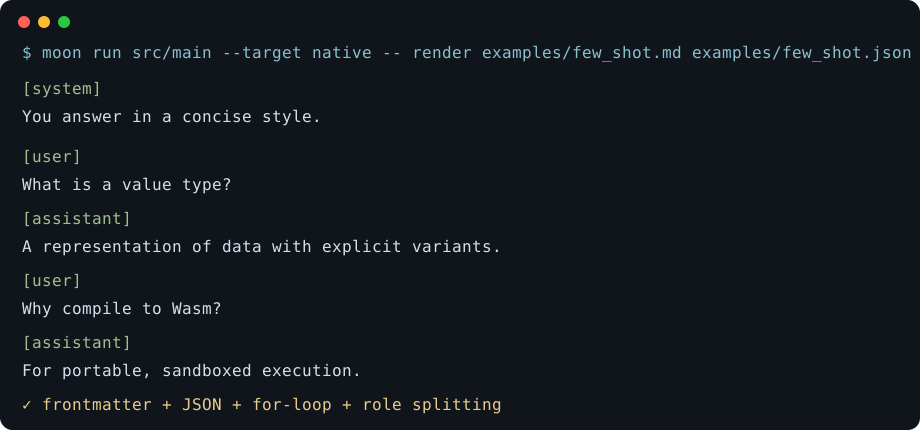
For few-shot prompts, place examples in an array and generate turns with a for
block before calling split_roles.
A complete few-shot template and data file are provided in examples/.
#Architecture
flowchart LR
  Text --> Lexer --> Parser --> AST --> Renderer --> Prompt --> RoleSplitter
  Variables --> Renderer
The library is split by responsibility (lexer, parser, renderer, filters,
frontmatter) while remaining one compilation package, which prevents cyclic
dependencies and keeps public types simple. See architecture notes.
The public API also includes static template statistics and variable discovery,
strict role validation, compiler-style diagnostics, deterministic Value/Vars
adapters, render reports and limits, filter metadata, newline normalization, and
opt-in conservative input-security inspection. Security inspection reports
suspicious input; it does not claim to automatically prevent prompt injection.
#Development
moon check src/lib --target wasm-gc
moon test src/lib --target wasm-gc
moon check src/lib --target js
moon test src/lib --target js
moon check --target native
moon test --target native
CI treats warnings as errors for every target. The checked library contains no
backend-specific extern declarations; the native-only boundary is isolated in
src/main and moonbitlang/x/fs.
The current suite contains more than 200 assertions across parser, renderer,
filters, invalid syntax, JSON/frontmatter, roles, diagnostics, analysis, adapters,
limits, and end-to-end document rendering.
发布到 mooncakes.io:
moon login
moon package --list
moon publish#Roadmap / non-goals for MVP
Macro definitions, inheritance/includes, user filter registration, native function
calls, a global escaping switch, template caching, and concurrent rendering are not
implemented. Future releases may add these without changing the core AST contract.
#License
MIT. This is an original implementation and does not copy Jinja2 source code.
A pure MoonBit prompt template engine for LLM applications
llmprompttemplatejinjawasm

 0.1.0
0.1.0 MIT
MIT
 Updated 4 days ago
 1 downloads
Dependencies
- moonbitlang/x0.4.46